The Hidden Cost of Technical Debt: Why Leadership Should Care
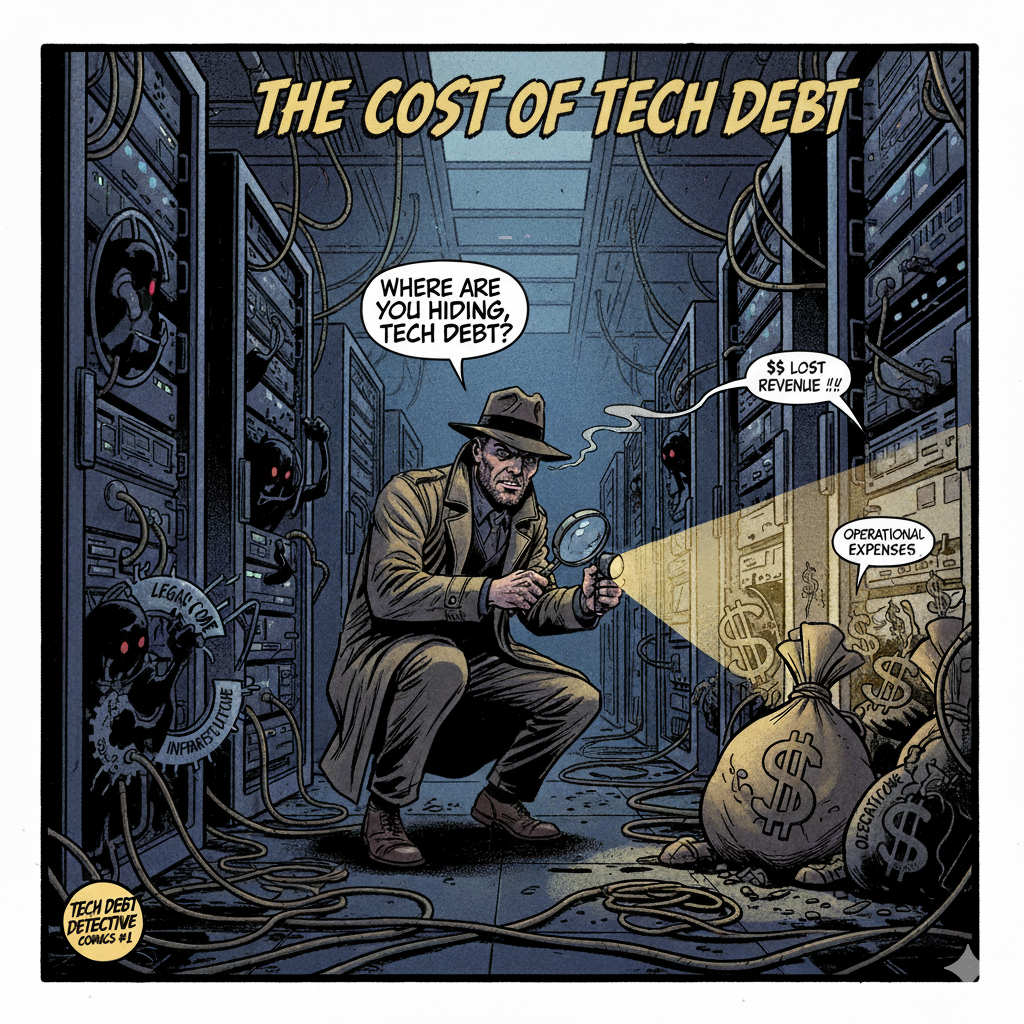
Recently, I was in a meeting where our CHRO asked a simple question: “Why does it take six months to add a new feature that seems straightforward?” Our EVP’s answer involved servers, databases, and integration challenges. The CHRO’s eyes glazed over after the first minute.
Sound familiar? This disconnect happens in organizations everywhere, and it’s costing businesses more than they realize. The culprit is not incompetent technology teams or unreasonable business expectations. It’s technical debt, and most leadership teams do not understand what it really means for their business and the drag it can create.
What Technical Debt Actually Looks Like
Technical debt is not just messy code that makes developers unhappy. It’s the accumulation of shortcuts, workarounds, and “temporary” solutions that compound over time to slow down everything your business wants to accomplish.
Here’s examples I’ve seen in real organizations:
A retail company wanted to launch personalized promotions. Simple request, right? But their customer data lived in seven different systems, none of which talked to each other properly. What should have been a three-month, $500K project turned into an eighteen-month $3M integration nightmare because of decisions made five years earlier to “just get something working quickly.”
A manufacturing company needed real-time inventory visibility across their supply chain. Their ERP system could do it, but years of proof of concepts (POC) scaled into solutions, customizations and patches meant that any change risked breaking critical business processes to the tune of nearly $1.5M lost for every hour of system downtime. They spent more time testing workarounds than building new capabilities.
A financial services firm wanted to improve their mobile app experience. But their core systems were built in the early 2000s with integration patterns that couldn’t handle modern API requirements. Every new feature required extensive middleware development and customization just to connect old systems to new interfaces. This introduced additional layers of error opportunities, increased time to troubleshoot issues and slowed app performance by seconds in a competitive landscape measured by milliseconds.
In each case, the business impact was clear: slower time to market, higher costs, reduced competitive agility, and frustrated customers. However, the root cause in each case was invisible to leadership until it became a crisis.
Why Leadership Should Care Right Now
Technical debt is not just an IT problem. It’s a business strategy problem that affects every part of your organization.
Innovation Speed: Every new initiative gets slower and more expensive as technical debt accumulates. Your competitors are not dealing with the same legacy constraints, so they can move faster and cheaper than you.
Customer Experience: Technical debt creates the glitches, slow responses, and integration failures that customers notice. When your systems can’t keep up with customer expectations, you lose market share.
Operational Risk: Heavily modified legacy systems are fragile. The more workarounds you build, the more likely something will break at the worst possible moment. And when it breaks, it’s harder and more costly to fix.
Talent Retention: Good developers do not want to spend their careers working on outdated technology, maintaining fragile systems and working around technical constraints. Technical debt makes it harder to attract and retain the people you need to innovate.
Total Cost of Ownership: Organizations with significant technical debt spend 60-80% of their IT budget just keeping existing systems running. That leaves very little for innovation or competitive differentiation.
How Technical Debt Accumulates
Understanding how you got here is crucial for preventing it from happening in the future. Technical debt rarely appears overnight. It builds up through seemingly reasonable decisions made under business pressure.
The Pressure Cooker Effect: Business deadlines are real, and “perfect” solutions take time you don’t have. So teams build quick fixes and promise to “come back and do it right later.” But “later” never comes because there’s always another urgent deadline.
The Integration Trap: Business acquisitions, new vendor relationships, leadership changes and changing requirements all demand system integration. Under pressure, teams build point-to-point connections instead of proper integration architecture. Each connection works fine individually, but collectively they create a web of dependencies that’s impossible to modify safely and requires significant regression testing for each change.
The Customization Spiral: SaaS platforms and enterprise software packages provide 80% of what you need out of the box. But that missing 20% drives extensive customization that makes upgrades risky and expensive. Over time, you end up with a heavily modified system that is expensive to maintain and difficult to replace. Patches and upgrades become monumental as the platform ages due to the significant work required to further maintain or re-customize followed by more regression testing. All of this drives IT costs higher and higher the longer the system is in service.
The Skills Gap: When the developers who built your systems move on, institutional knowledge leaves with them. The remaining team understands how things work today but not why they were built that way. This makes any change risky because no one fully understands the implications.
A Framework for Managing Technical Debt
Technical debt is not completely avoidable, but it can be managed strategically. Here’s the approach I use with my teams to make it visible and manageable for business leadership.
Make It Visible: Create a simple classification system that translates technical complexity into business impact. We use three categories: “Slowing us down” (affects project timelines), “Costing us money” (requires extra resources or workarounds), and “Creating risk” (could cause system failures or security issues). These are easily relatable phrases that business stakeholders and tech teams can quickly understand.
Quantify the Impact: For each major area of technical debt, estimate the business cost. How much longer do projects take? How much extra effort is required for maintenance? What’s the cost of the workarounds you’ve built? Put dollar figures on these impacts so leadership can make informed investment decisions.
Prioritize Strategically: Not all technical debt needs to be fixed immediately. Focus first on debt that directly impacts your most important business initiatives. If you’re launching new customer-facing features, prioritize customer data systems. If you’re expanding to new markets, focus on the systems that need to scale or adapt.
Build It Into Planning: Technical debt remediation should be part of your regular planning cycles, not a separate initiative that competes with business projects. When planning new features or capabilities, include the technical debt work required to implement them properly.
Invest in Prevention: The cheapest technical debt to manage is the debt you do not create. Establish architecture standards, code review processes, and integration patterns that prevent the most common sources of technical debt. Negotiate with business leaders for achievable timelines that reduce the need to scale a POC or just quickly connect with intention to revisit later.
Making the Business Case
When you’re ready to address technical debt, you need to speak the language that resonates with business leadership. Here’s how I’ve been successful framing the conversation:
Connect to Business Outcomes: Don’t talk about code quality or system architecture. Talk about faster time to market, reduced operational costs, and improved employee and/or customer satisfaction. Show how technical debt is preventing the business from achieving its strategic goals.
Present Options and Trade-offs: Leadership needs to understand their choices. Present multiple approaches with different timelines, costs, and risk profiles. Always be sure to highlight the preferred option as your recommendation. Maybe you can’t fix everything at once, but you can show progress toward specific business capabilities.
Show Quick Wins: Identify areas where modest technical debt reduction can produce measurable business value quickly. Success builds credibility and momentum for larger investments.
Include Risk Assessment: Help leadership understand what happens if you don’t address critical technical debt. What business capabilities become impossible? What operational risks increase? What competitive disadvantages emerge? How will customers or employees be impacted?
The Long-Term Perspective
Managing technical debt effectively requires changing how your organization thinks about technology investments. It’s not just about building new capabilities; it’s about maintaining the foundation that makes future capabilities possible.
The organizations that manage technical debt well treat it like physical infrastructure maintenance. You don’t wait for the roof to collapse before you fix it. You invest in ongoing maintenance to prevent bigger problems and enable future improvements.
This requires partnership between technology and business leadership. IT teams need to communicate technical constraints in business terms. Business leaders need to factor technical sustainability into their strategic planning and project timelines.
The payoff is significant: faster innovation, lower operational costs, reduced risk, and the agility to respond quickly to market opportunities.
Getting Started
If technical debt is slowing down your organization, here’s how to begin addressing it:
Start with assessment. Identify your top three business initiatives for the next year. Then work with your technology team to understand what technical debt is preventing or slowing down those initiatives.
Quantify the impact in business terms. How much longer will these initiatives take? How much will they cost? What workarounds will you need?
Present options to leadership. Show what’s possible with different levels of technical debt investment. Help them understand the trade-offs between speed, cost, and long-term sustainability.
Most importantly, make technical debt management an ongoing conversation, not a one-time project. The organizations that stay competitive are the ones that balance innovation with technical sustainability consistently over time.
What’s the technical debt costing your organization? The answer might surprise you, and addressing it might be the key to unlocking your next phase of growth.
How does technical debt show up in your organization? I’d love to hear about the challenges you’re facing and the approaches that are working. Connect with me on LinkedIn or Substack to continue the conversation.