The Three Conversations Every Director Must Master
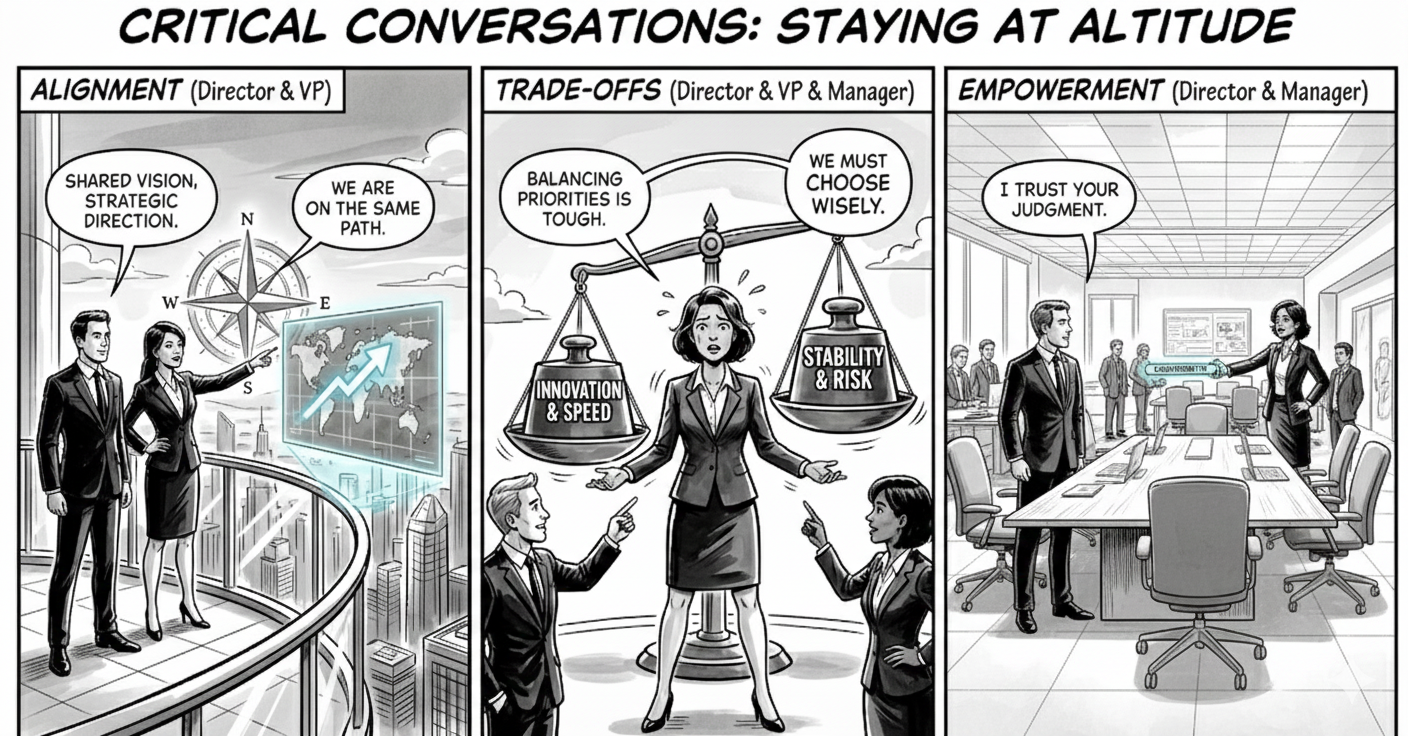
Why Conversations Become Your Most Critical Tool
When you move from manager to director, the conversations you have start to change. Each role matters and serves a different purpose, but at the director level the stakes rise, and the conversations become more complex.
For managers, most discussions center on execution. How is the team delivering against the strategy and milestones? What obstacles are slowing things down? How does the run rate compare to the plan? These conversations keep work on track and help teams deliver outcomes that support the broader strategy.
When you step into a director role, your conversations shift. You still pay attention to execution, but more of your time is spent talking about vision, priorities, alignment, and trade-offs. Directors help the organization decide what matters most, what can wait, and what isn’t worth pursuing. Your effectiveness depends on how well you navigate the conversations that shape direction, build trust, and guide decisions.
So where should you focus? Start by mastering these three conversations that consistently separate strong directors from everyone else.
Conversation 1: The Alignment Conversation
The first conversation every director must master is the alignment conversation. Alignment isn’t just about agreement. It’s making sure your peers and stakeholders share a common understanding of the vision, the priorities, and the outcomes that matter. When people are rowing in the same direction, the work moves faster and decisions get easier. When they aren’t, everything slows down.
This conversation can be challenging, especially when you’re new in role. Each peer, stakeholder, and even the managers reporting to you will have different agendas, pressures, and interpretations. Everyone hears things through their own lens. The goal of the alignment conversation is to build shared commitment to the direction, not just surface-level consensus.
So how do you get there? Directors need to become strong storytellers. Instead of giving status updates, you’re shaping the narrative. Set the context for why this matters, what outcomes the business needs, and what’s at stake if nothing changes. Translate technology decisions into clear business value and avoid technical jargon. And never assume people “get it.” Surface misalignment early, not after decisions have already been made.
One experience that shaped the way I think about alignment was when I made the case for building our own middleware instead of buying a third-party product. We had struggled for years to bring data together from separate systems with inconsistent models, which made it hard to produce the insights the business needed. The idea of building middleware felt abstract to many leaders, so I developed a story built around a simple narrative arc: the problem, the consequences of doing nothing or buying the wrong solution, and how our approach would enable better, faster business decisions.
Early on, the story resonated and I secured support. But when the business climate shifted, priorities changed and the proposal lost momentum. That experience taught me that alignment isn’t a one-time event, rather it has to hold up under pressure. Strong strategies stay tied to business outcomes and can be realigned without losing their purpose or momentum.
This leads directly into the next type of conversation: knowing when and how to be flexible.
Conversation 2: The Trade-Off Conversation
The second conversation every director must master is the trade-off conversation. These are often the most challenging discussions because they sit at the intersection of limited resources, competing priorities, and organizational dynamics. But they are also some of the most important. Trade-off conversations are how leaders make informed choices about what to pursue, what to pause, and what to stop.
Strong directors don’t try to avoid trade-offs or pretend they don’t exist. They accept that time, people, and budget are finite. Their role is to surface the trade-offs clearly and help the organization focus its energy on what matters most.
To be effective in these conversations, directors need to do a few things well. First, they must present clear options. Each option should include risks, benefits, and impacts, both positive and negative. That includes being explicit about the cost of doing nothing. Without this clarity, decisions tend to drift or default to the loudest voice in the room.
Second, directors must keep the conversation anchored in business strategy and outcomes, not technical preference. These discussions can quickly devolve into debates about tools, architectures, or implementation details. The director’s job is to redirect the focus to value, timing, and business impact.
Finally, trade-off conversations require composure and ownership. Stakes are often high, emotions can surface, and politics are unavoidable. Calm, steady leadership builds trust in those moments. Effective directors guide the conversation toward a decision rather than waiting for someone else to step in. Once a decision is made, they ensure there is shared understanding of what was approved, what was deferred, and why.
I recently faced a situation where I had to choose between what was best for one team and what was best for the organization. After quick conversations with my team leads to understand the implications, I chose the organizational path. The decision was uncomfortable in the short term, for both the team and me, but it allowed us to realign around the most important priorities. Over time, it proved to be the right call and ultimately delivered more value for the business and the individuals involved.
Once a trade-off is made, the real test begins. Decisions only create value when leaders across the organization are trusted and empowered to act on them.
Conversation 3: The Empowerment Conversation
As directors step away from day-to-day execution, the work doesn’t disappear. It moves to their managers and leads. The empowerment conversation is how directors build the confidence and capability of those leaders so decisions don’t keep flowing back up the chain. This shift can be especially hard for new directors, because execution is familiar and comfortable. But the more you cling to it, the harder it becomes to operate at the strategic level.
Empowerment starts with clarity. Directors need to set clear expectations around outcomes, define the guardrails, and explicitly delegate authority. That means being clear about what success looks like, where the boundaries are, and who owns the decision. Just as important, once authority is delegated, directors need to give leaders the space to use it. Stepping back is often the hardest part.
One lesson that has stayed with me comes from coaching youth soccer, and it translates directly to business. Teams grow faster when leaders coach instead of direct. When you give instructions, people naturally look back to you for the next answer. When you coach, often by asking questions, you reinforce trust and help others build judgment. The people closest to the work usually understand the best path forward. Your role is to help them think through decisions, not make every decision for them.
I learned this the hard way, even though I trusted my teams, I stayed too involved in execution. I joined meetings I didn’t need to be in and weighed in on decisions my leaders were fully capable of making. Over time, I realized that my presence was slowing things down. Instead of building confidence, I was unintentionally signaling that decisions still needed my approval. Letting go wasn’t easy, but it was necessary.
Empowerment doesn’t mean disengagement. Directors still need to be accessible, but availability is different from micromanagement. When leaders know they can reach you for guidance, they think more critically and take more ownership. When they feel monitored, they default to compliance. Maintaining that balance creates space for you to focus on the bigger picture while enabling your teams to move faster and deliver with more confidence.
When directors stay focused on outcomes and priorities, those priorities become part of the guardrails. They guide day-to-day decisions without requiring constant oversight. That’s when empowerment turns into leverage, and when organizations begin to scale effectively.
Why These Conversations Define Director-Level Impact
Each of these conversations plays a critical role in director-level success. As your scope expands, the way you are measured changes. The focus moves away from individual contributions and toward the clarity you create, the decisions you enable, the leaders you empower, and the value your organization delivers.
Mastering these three conversations is a clear signal that you are operating at the right altitude and building impact at the enterprise level.
Which of these conversations do you find most challenging? Which are you actively working to improve? I’d love to hear about the shifts you’re making as you step into broader leadership roles and the approaches that are working for you. Connect with me on LinkedIn or Substack to continue the conversation.
Image generated with support from Gemini Nano Banana